

Newborn screenings can help identify conditions shortly after birth that may otherwise be unidentifiable at that age.
What is the newborn screen?
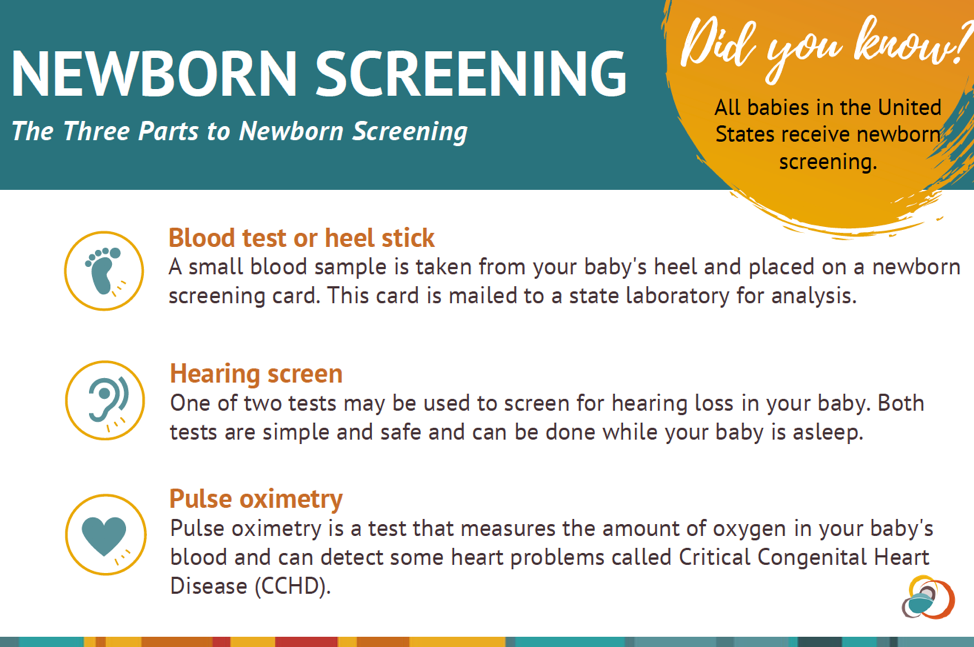
When most babies are born, they appear healthy to the unassuming eye. Yet, a simple heel stick for a bit of blood 24 hours after birth for routine laboratory bloodwork screening can determine if they may have certain genetic disorders that can be treated early on. Other important components of the newborn screen (pulse oximetry and hearing screen) are administered on-site at the baby’s birth center.
The federal Newborn Screen Saves Lives Act (renewed and revised every ~5 years) covers recommended disorders, however it is up to each state to determine the disorders that it routinely screens for. By screening for severe, yet treatable disorders, state-mandated newborn screening programs are able to detect and subsequently remedy a variety of metabolic, hormone, hemoglobin, and other disorders. This gives children the ability to reach their full potential.
Upon screening your baby for the aforementioned disorders, your medical provider will contact you should any abnormal laboratory results arise, and likely discuss a treatment plan for your newborn’s condition.
Common misconceptions
Myth: All states screen for the exact same types and number of disorders
Fact: Each state’s newborn screening program is different. Some states screen for ~30 disorders, whereas others screen for over 60 disorders. This can lead to a discrepancy in health outcomes of residents in different states.
Myth: Newborn screening can confirm a diagnosis.
Fact: Further, specific testing will need to be done to confirm a diagnosis.
Myth: Parents can easily opt their newborn out of screening.
Fact: All babies born within the United States will be screened. Parents are able to opt their child out of newborn screening due to religious reasons
Categories of disorders
Aminoacidopathies: Aminoacidopathies are disorders that primarily involve dysregulation of amino acids. Early treatment tends to surround dietary management.
Congenital Infectious Diseases: Congenital infectious diseases include infections by parasites, bacteria, or viruses in most cases. They’re treated by infectious disease specialists.
Cystic Fibrosis: Cystic fibrosis causes a buildup of thick, sticky mucus within the baby’s lungs and other potential organs, causing infections and damage to the organs. Individuals with cystic fibrosis tend to be treated by pulmonologists.
Endocrinopathies: Endocrinopathies are disorders whereby the affected baby cannot produce endogenous hormones. Oftentimes, these individuals are treated with hormone therapies by endocrinologists.
Enzyme Deficiencies for Vitamins and Sugars: Babies with enzyme deficiencies for vitamins and sugars do not have the proteins to break down vitamins and sugars. Oftentimes, metabolic specialists treat patients with these disorders.
Fatty Acid Oxidation Disorders: Fatty acid oxidation disorders (FAODs) occur in babies who cannot use stored fat deposits when they’re low on energy. Individuals with FAODs must consistently eat and maintain certain caloric intake to avoid situations that put them at a low energy state. Metabolic specialists tend to treat patients with such disorders.
Hemoglobinopathies: Hemoglobinopathies are a group of disorders that affect the quality and quantity of red blood cells. Babies affected with a hemoglobinopathy could undergo pain crises, sickle cell disease, and similar effects. Hematologists tend to treat patients with such disorders.
Organic Acid Disorders: Organic acid disorders involve conditions whereby affected babies cannot break down lysine or branched chain amino acids found in common foods. Individuals affected by such disorders are treated through special diets in conjunction with other therapies. Metabolic specialists treat these individuals.
Severe Combined Immunodeficiency: Severe combined immunodeficiency is a condition whereby affected babies are not able to fight off infections. Babies can die from having this disorder within the first few months. Affected individuals tend to undergo a bone marrow transplant, allowing for production of white blood cells to hoist an immune response. Immunologists and transplant specialists treat these patients.
Urea Cycle Disorders: Urea cycle disorders are reflective of a high level of ammonia within a baby’s bloodstream, as the body is not able to get rid of nitrogen buildup within the bloodstream. Individuals with these disorders must receive immediate care and treatment by a metabolic specialist.
Resources
The following linked resources are well-curated and contain up-to-date information on the newborn screen within the United States.
American Academy of Pediatrics
Everylife Foundation for Rare Disease: Newborn Screening
Screening by State
-
The mandatory Massachusetts Newborn Screening (NBS) Program has been administered through the state medical laboratory at the University of Massachusetts Medical School since July 1, 1977. Disorders found to be within the Required Newborn Screening are thought to be quite treatable. Some of these disorders are more common, and have data that generally show positive trends in the quality of life outcomes for babies who have undergone NBS. Other disorders are rarer and have limited data on quality of life outcomes of babies who have undergone treatment for a disorder detected at birth. The 32 disorders screened for in the state of Massachusetts include:
Argininemia (ARG)
Argininosuccinic acidemia (ASA)
β-Ketothiolase deficiency (BKT)
Biotinidase deficiency (BIOT)
Carbamoylphosphate synthetase deficiency (CPS)
Carnitine: acylcarnitine translocase deficiency (CACT)
Carnitine uptake defect (CUD)
Citrullinemia (CIT)
Congenital adrenal hyperplasia (CAH)
Congenital hypothyroidism (CH)
Congenital toxoplasmosis (TOXO)
Cystic fibrosis (CF)
Galactosemia (GALT)
Glutaric acidemia type I (GAI)
Homocystinuria (HCY)
3-hydroxy-3-methyl glutaric aciduria (HMG)
Isovaleric acidemia (IVA)
Long-chain L-3-OH acyl-CoA dehydrogenase deficiency (LCHAD)
Maple syrup disease (MSUD)
Ornithine transcarbamylase deficiency (OTC)
Phenylketonuria (PKU)
Sickle cell anemia (Hb SS)
Hb S/C disease (Hb SC)
Hb S/β-thalassemia (Hb S/βTh)
Medium-chain acyl-CoA dehydrogenase deficiency (MCAD)
Methylmalonic acidemia: mutase deficiency (MUT) Image Source
Methylmalonic acidemia: cobalamin A, B (Cbl A,B)
Methylmalonic acidemia: cobalamin C,D (Cbl C,D)
Propionic acidemia (PROP)
Severe Combined Immunodeficiency (SCID)
Tyrosinemia type I (TYR I)
Very long-chain acyl-CoA dehydrogenase deficiency (VLCAD)
In addition to the aforementioned disorders, the MA NBS can reveal other disorders as by-product of its screening protocols. The list of secondary conditions could be found here.
-
Every newborn in Connecticut (CT) receives the NBS 1 to 3 days after birth. The CT NBS Program was established in 1964, and since then, has expanded to covering up to 34 core conditions. CT NBS Core Conditions:
Arginosuccinic Aciduria (ASA)
Citrullinemia Type I (CIT I)
Homocystinuria (HCY)
Maple Syrup Urine Disease (MSUD)
Phenylketonuria (Classic) (PKU)
Tyrosinemia Type I (TYR I)
Galactosemia (Classical) (GALT)
Congenital Adrenal Hyperplasia (CAH)
Congenital Hypothyroidism (CH)
Long Chain Hydroxyacyl-CoA Dehydrogenase Deficiency (LCHAD)
Medium Chain Acyl-CoA Dehydrogenase Deficiency (MCAD)
Trifunctional Protein Deficiency (TFP)
Very Long Chain Acyl-CoA Dehydrogenase Deficiency (VLCAD)
S, βeta-thalassemia (Sickle Beta Thalassemia) (Sβ-Thal)
S,C Disease (Hemoglobin SC)
S,S Disease (Sickle Cell Disease) (Hemoglobin S)
Severe Combined Immunodeficiency Syndrome (SCID)
Biotinidase Deficiency (BIO)
3-Hydroxy-3-Methylglutaryl CoA Lyase Deficiency (HMG)
3-Methylcrotonyl CoA Carboxylase Deficiency (3MCC)
Beta-Ketothiolase Deficiency (BKT)
Glutaric Acidemia Type 1 (GA I)
Isovaleric Acidemia (IVA)
Methylmalonic Acidemia (MMA)
Methylmalonic Acidemia caused by cobalamin A or cobalamin B deficiencies (Cbl A, B)
Methylmalonic Acidemia with Homocystinuria (Cbl C, D) (Cbl C, D)
Propionic Acidemia (PPA)
Critical Congenital Heart Disease (CCHD)
Cystic Fibrosis (CF)
Hearing Loss (Hearing)
X-Linked Adrenoleukodystrophy (ALD)
Multiple CoA Carboxylase Deficiency (Called Holocarboxylase Synthetase deficiency on RUSP) (MCD)
S, Beta-Thalassemia (Hemoglobin Sβ° Thal)
Spinal Muscular Atrophy (SMA)
CT NBS Program secondary conditions could be found here.
-
The Maine Bloodspot Newborn Screening Program was established in 1965. Every newborn is required to have Bloodspot Newborn Screen. The Program has expanded to include 30 core conditions. Maine Bloodspot Newborn Screening Program core conditions:
3-Hydroxy-3-Methyglutaric Aciduria (HMG)
3-Methylcrotonyl-CoA Carboxylase Deficiency (3MCC)
Argininosuccinic Aciduria (ASA)
B-Ketothiolase Deficiency (BKT)
Biotinidase Deficiency (BIOT) (PDF)- Fact Sheet
Carnitine uptake Defect/Carnitine Transport Defect (CUD)
Citrullinemia Type I (CIT)
Classic Galactosemia (GALT) (PDF)- Fact Sheet
Classic Phenylketonuria (PKU) |
Phenylketonuria - PKU (PDF)- Fact Sheet
Congenital Adrenal Hyperplasia (CAH) (PDF)- Fact Sheet
Congenital Hypothyroidism (CH) (PDF)- Fact Sheet
Cystic Fibrosis (CF) (PDF)- Fact Sheet
Glutaric Acidemia Type I (GAI)
Holocarboxylase Synthase Deficiency (MCD)
Homocystinuria (HCY) (PDF)- Fact Sheet
Isovaleric Acidemia (IVA)
Long-chain L-3 Hydroxyacyl-CoA Dehydrogenase Deficiency (LCHAD)
Maple Syrup Urine Disease (MSUD) (PDF)- Fact Sheet
Medium-chain Acyl-CoA Dehydrogenase Deficiency (MCAD)
Methylmalonic Acidemia (MUT)
Methylmalonic Acidemia Cobalamin A, B (Cbl A, B)
Propionic Acidemia (PROP)
S,S Disease (Sickle Cell Anemia) (Hb SS)
S/Beta-Thalassemia (Hb S/BTh)
Severe Combined Immunodeficiencies (SCID)
S,C Disease (Hb S/C)
Trifunctional Protein Deficiency (TFP)
Tyrosinemia Type I (TYR I)
Very Long-chain Acyl-CoA Dehydrogenase Deficiency (VLCAD)
Maine Bloodspot Newborn Screening Program secondary conditions could be found here.
-
The Vermont Newborn Screening (NBS) Program recommends screening for 33 conditions via blood test.
Vermont Newborn Screening core conditions:
3-Methylcrotonyl-CoA carboxylase deficiency (3MCC)
3-OH 3-CH3 glutaric aciduria (HMG)
Argininosuccinic acidemia (ASA)
Beta-ketothiolase deficiency (BKT)
Biotinidase deficiency (BIOT)
Carnitine uptake defect (CUD)
Citrullinemia (CIT)
Congenital adrenal hyperplasia (CAH)
Congenital hypothyroidism (CH)
Cystic fibrosis (CF)
Galactosemia (GALT)
Glutaric acidemia type I (GA I)
Hb S/Beta-thalassemia (Hb S/Th or Hb S/A)
Hb S/C disease (Hb S/C)
Holocarboxylase synthetase deficiency (MCD or multiple carboxylase deficiency)
Homocystinuria (HCY)
Isovaleric acidemia (IVA)
Long-chain L-3-OH acyl-CoA dehydrogenase deficiency (LCHAD)
Maple syrup urine disease (MSUD)
Medium-chain acyl-CoA dehydrogenase deficiency (MCAD)
-
The New Hampshire Newborn Screening Program screens for 32 conditions. New Hampshire Newborn Screening Program core conditions:
3-Hydroxy-3-Methylglutaryl-CoA Lysase Deficiency
3-Methylcrotonyl-CoA Carboxylase Deficiency
Argininosuccinic Aciduria
Argininemia
Biotinidase
Carnitine Uptake Defect
Carnitine Palmitoyltransferase II Deficiency
Citrullinemia I (ASA Synthetase Def)
Cobalamin A, B
Congenital Adrenal Hyperplasia (CAH)
Congenital Toxoplasmosis
Cystic Fibrosis (CF)
Galactosemia
Glutaric Aciduria Type I
Homocystinuria (HCY)
Hyperornithinemia
Hyperammoninemia
Homocitrullinemia Syndrome
Isovaleric Acidemia
Long Chain 3-hydroxyacyl-CoA Dehydrogenase Deficiency
Maple Syrup Urine Disease (MSUD)
Medium Chain Acyl CoA Dehydrogenase Deficiency (MCAD)
Methylmalonic Acidemia
Mitochondrial Acetoacetyl-CoA Thiolase Deficiency
Multiple Acyl-CoA Dehydrogenase Deficiency
Multiple Carboxylase Deficiency
Phenylketonuria (PKU)
Propionic Acidemia
Sickle Cell Disease (Hemoglobinopathies – 3 types)
Trifunctional Protein Deficiency
Tyrosinemia type I
Very Long Chain Acyl-CoA Dehydrogenase Deficiency
-
Rhode Island requires newborn screening for 33 conditions. Severe, associated health conditions could be treated when detected early by newborn screening. Rhode Island Newborn Screening core conditions:
Sickle cell anemia (SS)
Sickle/Beta-Thalassemia (S/Th)
Sickle/Hemoglobin C disease (S/C)
Phenylketonuria (PKU)
Maple Syrup Urine Disease (MSUD)
Homocystinuria (HCY)
Citrullinemia (CIT)
Argininosuccinic acidemia (ASA)
Tyrosinemia type I (TYR1)
Medium-chain acyl-CoA dehydrogenase deficiency (MCAD)
Very long-chain acyl-CoA dehydrogenase deficiency (VLCAD)
Long-chain 3-OH acyl-CoA dehydrogenase deficiency (LCHAD)
Trifunctional protein deficiency (TFP)
Carnitine uptake defect (CUD)
Isovaleric acidemia (IVA)
Glutaric acidemia type I (GAI)
Hydroxymethylglutaric aciduria/HMG-CoA lyase deficiency(HMG)
Multiple carboxylase deficiency (MCD)
Methylmalonic acidemia due to mutase deficiency (MUT)
Methylmalonic acidemia cblA and cblB forms (CBLA, B)
3-Methylcrotonyl-CoA carboxylase deficiency (3MCC)
Propionic acidemia (PROP)
Beta-ketothiolase deficiency (BKT)
Congenital hypothyroidism (CH)
Congenital adrenal hyperplasia (CAH)
Cystic Fibrosis (CF)
Glycogen Storage Disease Type II (Pompe)
Mucopolysaccharidosis Type I (MPS I)
Spinal Muscular Atrophy (SMA)
Biotinidase deficiency (BIOT)
Classical galactosemia (GALT)
Severe Combined Immunodeficiency (SCID)
X-linked Adrenoleukodystrophy (X-ALD)
References
1. New England Newborn Screening Program. Retrieved September 15, 2020, from https://nensp.umassmed.edu/
2. Newborn Screening Overview. (2020, September 11). Retrieved September 15, 2020, from https://everylifefoundation.org/newborn-screening/
3. The Connecticut Newborn Screening Program - Home. (n.d.). Retrieved October 20, 2020, from https://portal.ct.gov/DPH/Laboratory/Newborn-Screening/Newborn-Screening-Program
4. Division of Disease Prevention. (n.d.). Retrieved October 20, 2020, from https://www.maine.gov/dhhs/mecdc/population-health/mch/cshn/bloodspot-screening/index.html
5. Newborn Screening Program: Maternal & Child Health: Division of Public Health Services: New Hampshire Department of Health and Human Services. (n.d.). Retrieved October 20, 2020, from https://www.dhhs.nh.gov/dphs/bchs/mch/newborn.htm
6. Newborn Screening. (2020, September 14). Retrieved October 20, 2020, from https://www.healthvermont.gov/children-youth-families/health-care-children-youth/newborn-screening
7. State of Rhode Island: Department of Health. (n.d.). Retrieved October 20, 2020, from https://health.ri.gov/newbornscreening/